I have now added glyph group number display throughout the corpus site. At the same time, I have chosen to adopt a more consistent approach to displaying the numbers:
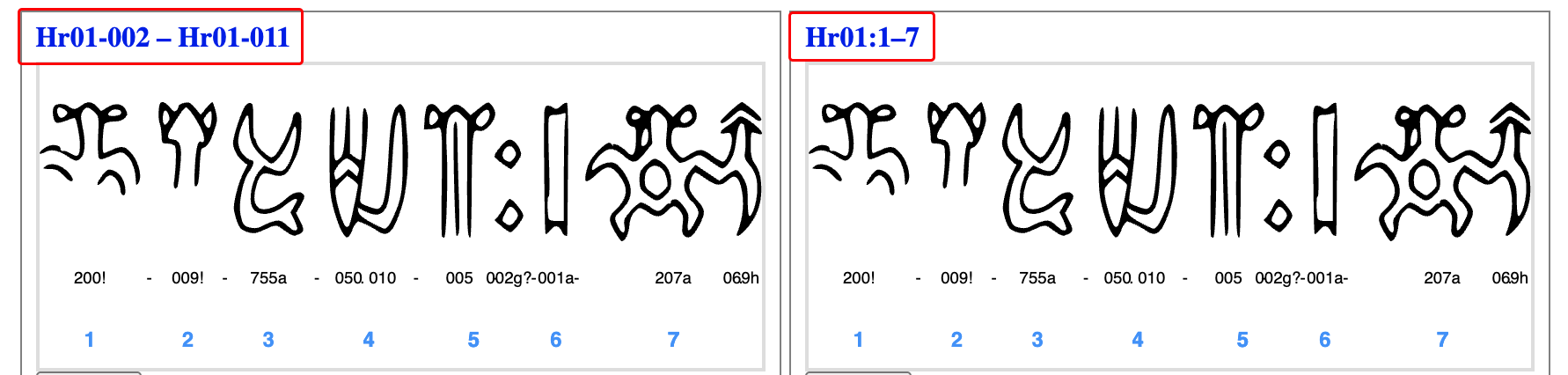
As seen in the above example, the snippet on the left is labelled using the site-specific “glyph ids”. Glyph ids have the line identifier followed by a hyphen and a 3 digit zero-padded number.

The snippet on the right is labelled using Horley-style glyph group numbers. Glyph group numbers are shown with the line identifier followed by a colon, and the numbers which are generally one or two digits—only rarely three digits. These numbers are shown without any “zero-padding”.

As of now the glyph group numbers are a display option throughout the website:

  • On the standard line-wise display of the corpus items
  • On the corresponding display with wrapped lines
  • In the glyph index, as a display option
  • In the new glyph list, as a display option
  • In the snippet viewer:
    • Glyph group numbers are displayed below the codes
    • Glyph group numbers are an option for choosing snippets
    • If the glyph group number option is chosen, the range is displayed as a glyph group number range, as illustrated in the example above
  • On the results of glyph searches in context
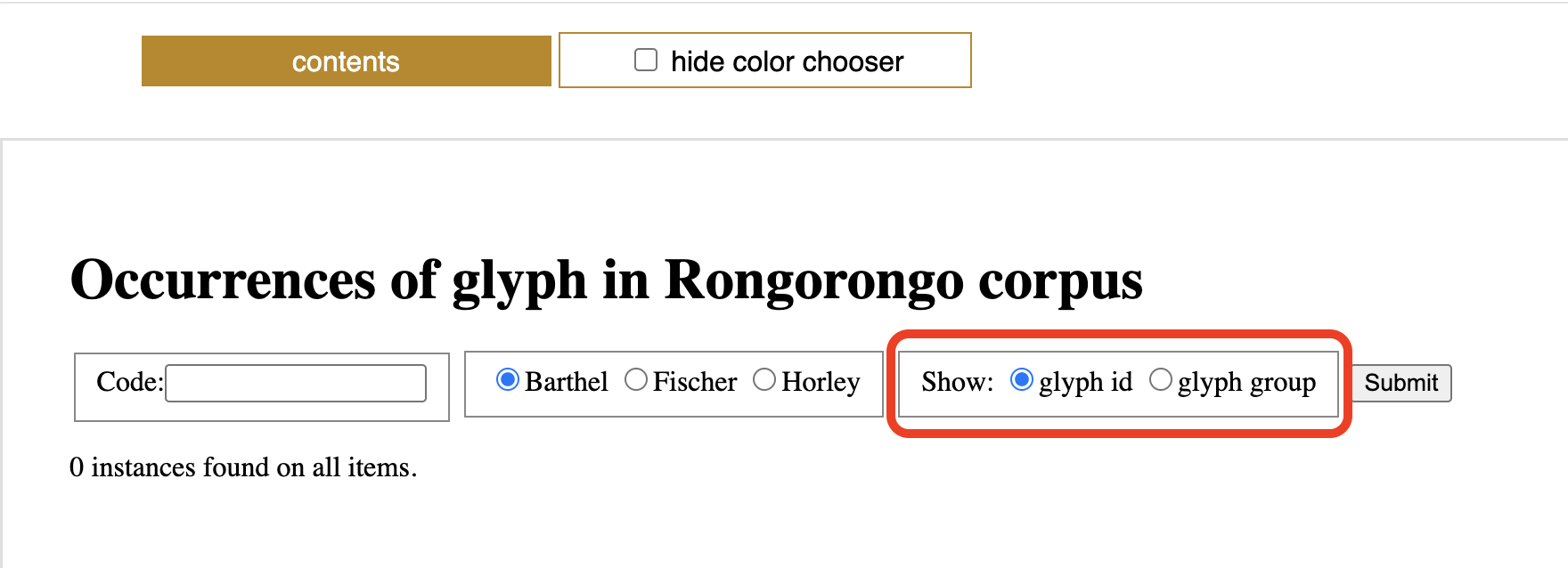
Up until now the glyph index showed all glyphs with the id number used to uniquely identify them in the corpus. I have now added an option to show Horley’s glyph group numbers instead. Below is an example of what results look like when this option is chosen.

More »

I have now added similar glyph group numberings for the tablets I, J, K, L, M and N. These numbers make it much easier to line up the drawings from Barthel and Fischer with those of Horley. This is particularly apparent in the case of tablets like M with extensive illegible sections.

Along with the numbers, lines and sides have been renamed or renumbered to match Horley’s insights.

  • For J and L the inscribed side is renamed “verso”
  • N has been changed from a/b to r/v
  • For M the line previously designated as Line 9 has been renamed Line 10 and turned upside-down, reversing the order for the 4 glyphs recognized.

In Horley’s seminal work (Horley, 2021) he introduces a way of referring unambiguously to locations on the tablets. He assigns each group of ligatured glyphs a number, ascending in the order of the writing direction. Recognizing a ligatured group should be fairly straightforward, even for the uninitiated. There are some tricky points however.

For one thing, some glyphs are still recognized as single glyphs, even though they consist of two isolated parts. For instance, glyph 017 consists of two isolated parts placed vertically, 053 consists of three lines, and 025 consists of two curved boxes which are sometimes drawn touching, but not always.

For another, Horley is very careful to distinguish instances of touching glyphs from those that are not, and numbers the groups accordingly. This happens even in cases where the touching or non-touching seems likely to be coincidental. This can also mean that he assigns separate numbers to glyphs that are drawn as linked by Barthel and/or Fischer, but where he determines that the linking is not present. Anyhow the numbers shown refer to the numbers in Horley’s work, regardless of the way they are shown by Barthel and Fischer. For this reason too, there will be skipped numbers, whenever Horley recognizes some glyph that the others did not see. And in a few cases Barthel, or more likely Fischer, sees a glyph that Horley does not recognize. Such glyph groups go un-numbered.

At the same time I am also bringing the numbering of tablet sides in line with Horley’s work. Horley provides evidence for renaming the sides of some of the tablet after providing arguments for determining which side is front (“recto”) and which should be the back (“verso”), Among the tablets that have so far been updated are the following:

  • A: Tahua is changed from a/b to r/v
  • B: Aruku-Kurenga is changed from r/v to a/b
  • C: Mamari is changed from a/b to r/v
  • D: Échancrée; as mentioned previously, the lines of side B are renumbered in opposite order, i.e., 1–6 becomes 6–1
  • Tablets E–H have also received glyph group numbers, but the side names stay the same

Creating the XML corpus required quite a bit of manual labor. Especially fiddly was subdividing the image files into individual glyphs. Obviously occasional errors happen. Cutting the svg images into their subparts, and then putting the correct ones back together again, and then making sure that each one has the correct number of images to match the number of glyphs and in the correct order.

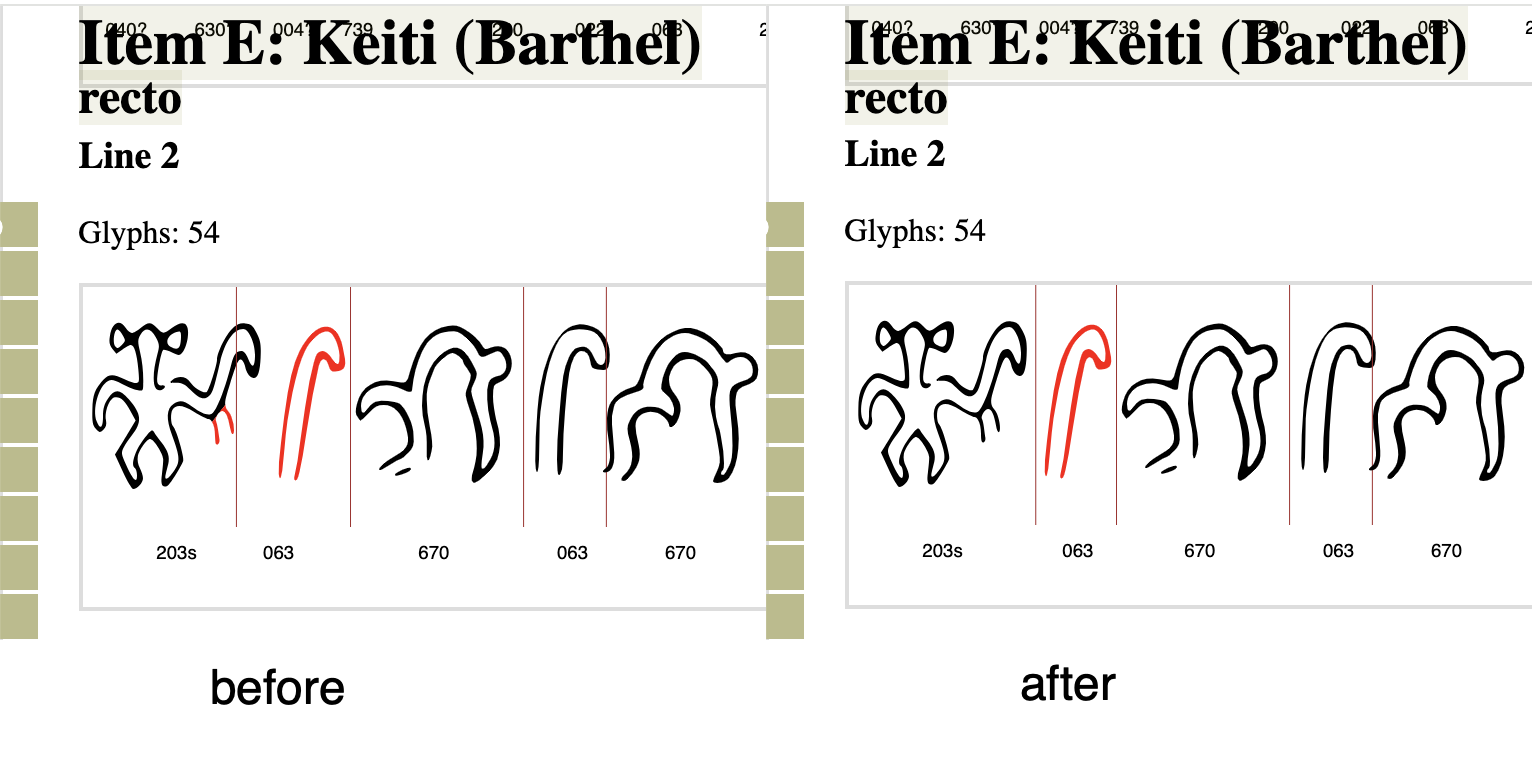
So even though I did all of this over 10 years ago, and have checked through it in different ways many times, sometimes I still discover errors. Such as the example above on Keiti, recto, line 2. The first two glyphs were mis-parsed. That’s fixed now.

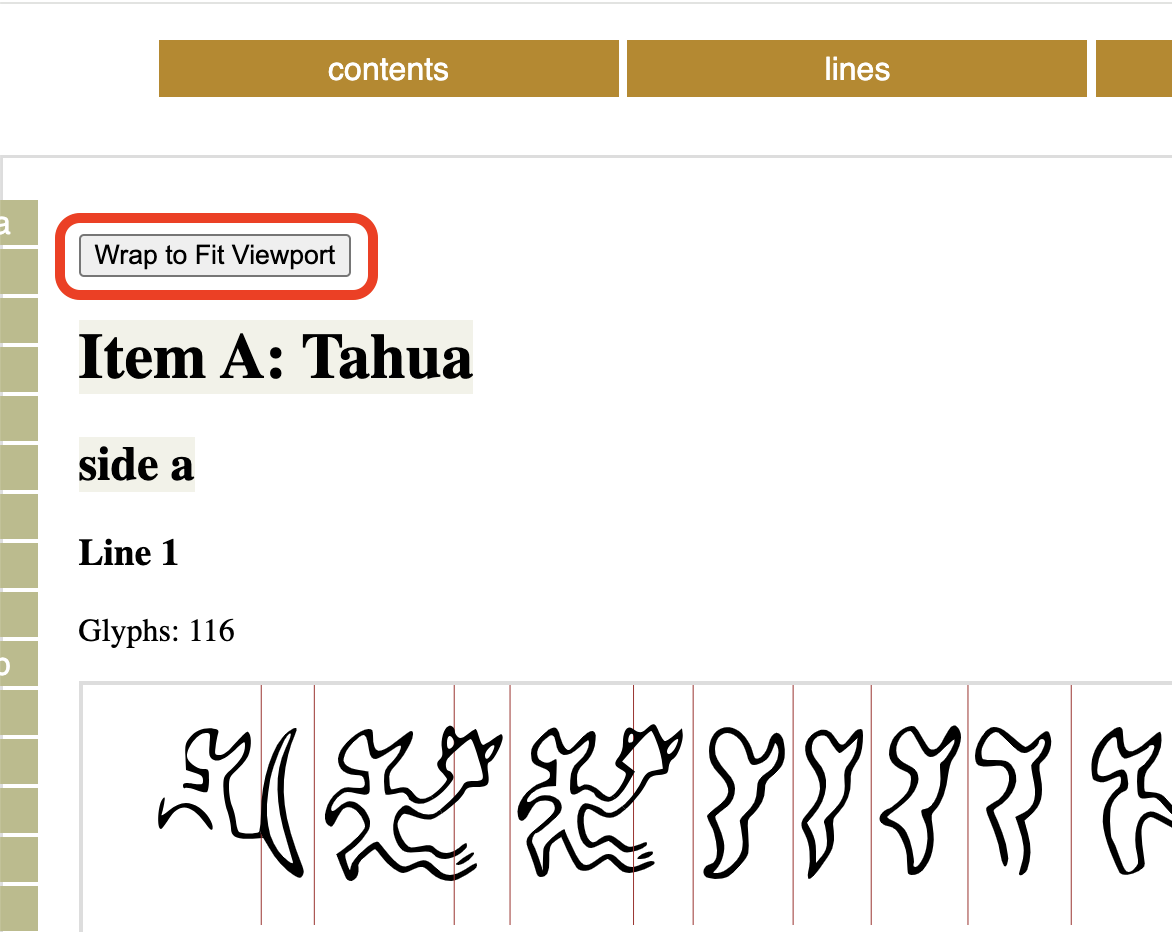
One of my proudest features has always been the display of the tablets with wrapped lines. But this has always just been set at a blunt 900 pixels. After improving the horizontal scrolling the other day, it occurred to me that I could also get the line wrapping to better use the full width of modern displays. So I have added a second wrapping button right above the tablet name. When clicked, it should reload the lines wrapped to the length possible in the user’s viewport.

Those who pay attention to the history of these items should know, Tablet D “Échancrée” was the first tablet that came to the outside world’s attention. When Bishop Jaussen became aware of this he tried to ask the Easter Islanders on Tahiti at the time to read it for him. When a volunteer named Metoro stepped forward, he revealed that the correct reading order for the tablets was to start at the edge closest to the reader, or the “bottom”, if one is treating the tablet like a page.

And generally researchers have taken great care to obey this order, and the lines in all of the corpus have been numbered in this fashion. However for tablets with even numbers of lines it can be quite tricky to determine which way is the “bottom”. And yet once this has been decided for the first side, the “bottom” edge for the second side will be the one closest to the “top” of the first.

Which makes it curious that Barthel did not observe the rule for this tablet. Horley reminds us of this fact and his work corrects the oversight. I am now following this, and have now corrected it in the corpus as well. So please be warned that the lines of Side b have now been renumbered, with Line 6 becoming Line 1, Line 5 becoming Line 2, and so forth.

I generally try to keep the code behind the corpus pages and their various features as simple as possible. I’m not into using flashy gimmicks or the like. My preference is; the fewer lines of CSS and Javascript the better.

But a major issue with these tablets is that the lines are very looooong, which leads to a lot of horizontal scrolling even on a big monitor. And the scrolling is really just the browser page scrolling, because the images don’t fit. So the line and tablet information quickly disappears, and you’re left looking at a long line of glyphs and wondering whether you even have the correct line in front of you.

So I finally (after what, 15 years?) got around to tweaking things, just a little bit. So now the pages in the corpus are arranged in such a fashion that any long lines will scroll within the page, and the line, side, and tablet information stays on the screen. No more looking at the end of a long line and wondering which line you are actually looking at! Also each line scrolls individually now. And it really wasn’t that hard. I should have done this long ago…

Some time ago I had noticed an error on Tablet G (“Small Santiago”), Verso, Line 1, where code “043t” was pointing to the wrong glyph. While this error was clearly mine, the seed for this error goes all the way back to Barthel himself. Barthel coded the preceding glyph combination as “33c.10f.76” when in fact it should have been “33c.10f.1.76″. At some point this got corrected to: “033c.010f.001” losing the “076” in the process. At any rate the “076” has now been restored and the “043t” code moved to the correct place.

Having been up and running for about 12 years now, I have undertaken a reorganization of this website. The following changes have been made:

  • The WordPress “blog” has now been made the main site. The static pages have been made the main entry site, while the “blog” itself has been relegated to an Updates page.
  • Relevant information from the old (hand-coded) HTML site has been moved to this site, updated and stream-lined.
  • The Corpus site, which presents the glyphs from the XML database, can be accessed from the main menu (as before). Pages for all the tablets have been added, and links to the Corpus page for each tablet can be found on those pages, along with other relevant info and links. The welter of old implementations of the corpus (low quality SVGs and PNGs) have been side-lined.

Please enjoy.